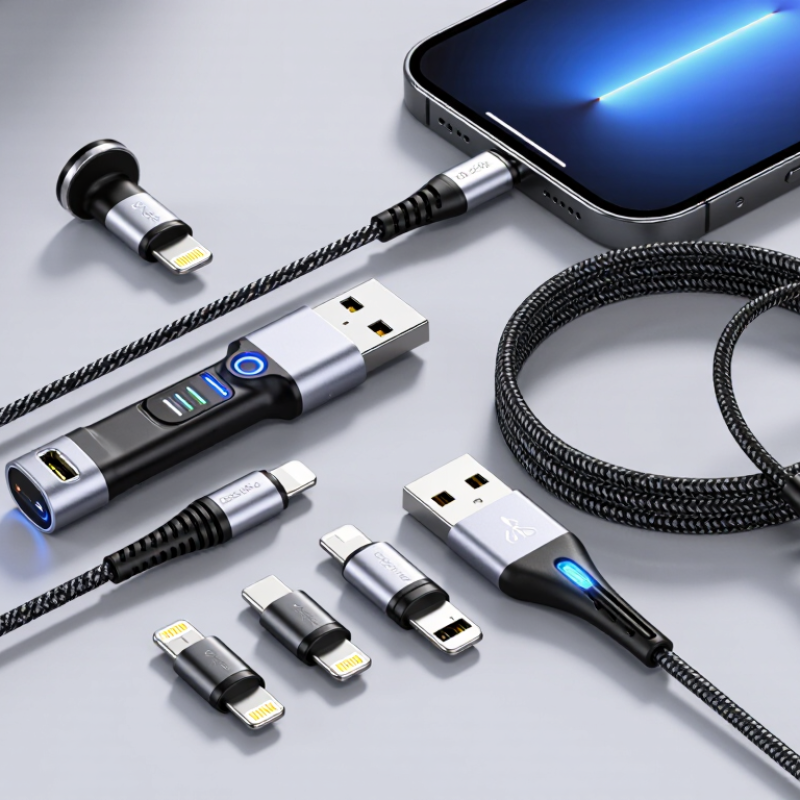
How to Choose Topk Magnetic Charging Cables for Wholesale

Time:2026-09-20 Author:Henry
0%

Choosing a Topk Magnetic Charging Cable for wholesale requires more than comparing unit prices. Buyers must examine compatibility, charging performance, durability, and supplier consistency. A cable may fit a customer’s phone perfectly, yet fail under repeated bending or weak magnetic contact.

Benson Leung, a recognized USB-C hardware expert, offers a practical warning: “USB-C is just the connector.” His point matters because connector shape does not guarantee power, data, or safety performance. Wholesale buyers should request samples and test actual charging results. Check rated current, supported wattage, data-transfer speed, magnet alignment, and heat during extended use. Small details matter. A loose magnetic tip can interrupt charging when a customer moves the phone.

Look closely at construction, too. Braided nylon should resist abrasion, while strain relief should remain firm near the plug. Ask whether replacement magnetic tips are available. Confirm packaging dimensions, labeling, lead times, and quality-control procedures before placing a large order. Verified test reports are useful, but hands-on inspection still reveals problems that documents may miss.

Price remains important, but the cheapest option can create higher return costs. A product that feels solid in the hand often earns trust faster. Still, no checklist catches every failure. Even experienced buyers can overlook inconsistent batches or connector wear. Start with a controlled trial order, record failure rates, and review customer feedback before scaling. This approach makes the Topk Magnetic Charging Cable easier to evaluate honestly, without assuming that attractive specifications always reflect real-world performance.

How to Choose Topk Magnetic Charging Cables for Wholesale

Define Wholesale Requirements for Topk Magnetic Charging Cables

Wholesale requirements for top-tier magnetic charging cables should begin with the buyer’s actual device mix. IDC’s Worldwide Quarterly Mobile Phone Tracker recorded approximately 1.24 billion smartphone shipments in 2024. That figure supports broad connector coverage, but not careless variety. Define required connector types, cable lengths, charging wattage, data-transfer speed, and magnetic tip compatibility. Samples should be tested with real customer devices, not only laboratory chargers.

Ask suppliers for electrical test records, material specifications, cycle-test results, and production traceability. USB-IF certification should be verified where applicable, especially for USB-C performance claims. Packaging also matters. A compact box with labeled tips reduces warehouse errors and customer confusion. Set measurable wholesale terms, including minimum order quantity, acceptable defect rate, inspection method, replacement policy, and delivery tolerance. Keep them written.

Sustainability deserves a practical check. The Global E-waste Monitor 2024 reported 62 billion kilograms of electronic waste in 2022, with only 22.3% formally collected and recycled. Choose recyclable packaging and avoid unnecessary adapter combinations. I would not trust a low price alone. Magnetic alignment can feel convenient, yet weak magnets, exposed contacts, or heat under load may create returns. A small pilot order is safer than a large assumption. Track charging failures, connector wear, packaging damage, and customer complaints for thirty days before scaling. gbc

Compare Connector Types, Device Compatibility, and Charging Standards

When choosing top magnetic charging cables for wholesale, compare connector types before price. USB-C is the most flexible option, but connector shape does not guarantee fast charging. USB-IF specifications show that USB Power Delivery 3.1 can support up to 240W, while actual devices may accept far less. Check whether each cable includes an e-marker chip and supports the promised current. A magnetic tip designed for legacy proprietary ports may fit older devices, yet fail with newer USB-C systems.

Compatibility requires practical testing. IDC reported roughly 1.2 billion smartphone shipments worldwide in 2024, creating a broad but fragmented accessory market. Test cables with phones, tablets, laptops, and power banks from different generations. Confirm tip alignment, charging stability, heat, and accidental disconnect behavior. Small details matter. A loose magnetic head can interrupt charging overnight.

Charging standards deserve equal attention. Look for clear support for USB PD, programmable power supply functions, and the correct cable wattage. Data transfer is another trap; some magnetic cables support charging only, while others support USB 2.0 or faster links. Ask suppliers for laboratory test records, connector-cycle results, and sample units. Certifications improve confidence, but paperwork can still miss real-world weaknesses. I would not trust a “240W” label without load testing, because wholesale returns often expose claims that looked convincing on paper.

How to Choose Topk Magnetic Charging Cables for Wholesale - Compare Connector Types, Device Compatibility, and Charging Standards

Cable Configuration Magnetic Connector Type Typical Device Compatibility Charging Interface Relevant Charging Standards Typical Power Class Data Transfer Capability Wholesale Selection Notes
USB-C to USB-C magnetic cable Reversible USB-C magnetic tip with detachable cable head Modern phones, tablets, handheld consoles, laptops, power banks, and other USB-C devices USB-C source to USB-C device USB Power Delivery; USB Type-C current and voltage negotiation; standard USB charging Up to 240 W only when the cable, connectors, charger, and device all support the required USB Power Delivery profile May support USB 2.0 data at up to 480 Mbps; many magnetic models are charging-only Best general-purpose configuration. Confirm electronic marking and power rating for products advertised above 60 W.
USB-A to USB-C magnetic cable Reversible USB-C magnetic tip with detachable cable head USB-C phones, tablets, accessories, and low-to-medium power devices USB-A source to USB-C device Standard USB charging; USB Battery Charging 1.2 may be supported by the source; USB Power Delivery is generally unavailable through a standard USB-A source Commonly 5 W to 15 W, depending on the source and cable design Often charging-only; some models support USB 2.0 data at up to 480 Mbps Suitable for broad accessory compatibility and entry-level wholesale bundles. Do not market it as a full USB Power Delivery cable.
USB-A to Micro-USB magnetic cable Micro-USB magnetic tip with detachable cable head Older Android devices, wireless speakers, power banks, cameras, controllers, and small electronics using Micro-USB USB-A source to Micro-USB device Standard USB charging; USB Battery Charging 1.2 may be supported by the source and device Commonly 5 W to 10 W USB 2.0 data may be available, but many magnetic versions are charging-only Useful for legacy-device demand. Verify connector orientation and mechanical fit because Micro-USB plugs are not reversible.
USB-C to Micro-USB magnetic cable Micro-USB magnetic tip with USB-C source connector Micro-USB accessories used with USB-C chargers, hubs, and power banks USB-C source to Micro-USB device Standard USB charging; USB Power Delivery features normally do not apply to the Micro-USB device side Commonly 5 W to 10 W Usually charging-only; data support must be specifically tested Appropriate for mixed-generation accessory packs. Clearly label the lower-power Micro-USB device side.
USB-C to 8-pin magnetic cable Reversible magnetic tip using an 8-pin device connector Selected mobile devices and accessories that use a compatible 8-pin charging port USB-C source to 8-pin device Device-specific charging negotiation; standard USB charging on the source side; USB Power Delivery may be available for compatible certified combinations Commonly 5 W to 20 W, subject to device, charger, cable, and accessory authentication requirements Usually charging-only unless the product has been specifically engineered and tested for data Keep connector listings separate from USB-C models. Compatibility can vary by device generation and accessory authentication.
Multi-tip magnetic charging cable Interchangeable USB-C, Micro-USB, and 8-pin magnetic tips Mixed fleets of phones, tablets, speakers, controllers, and other small electronics Usually USB-A or USB-C source with multiple device-side tips Depends on the source connector and attached tip; typically standard USB charging Commonly 5 W to 15 W; higher ratings require verified USB Power Delivery support and suitable cable construction Generally charging-only; data performance must be confirmed for each tip Strong SKU efficiency for wholesalers. Check tip retention, pin alignment, heat rise, and whether all included tips are electrically compatible.
Right-angle magnetic cable Magnetic tip with 90-degree device-side cable exit Gaming devices, handheld consoles, phones, tablets, and devices used while charging Available with USB-C, Micro-USB, or 8-pin device tips Follows the standard supported by the source connector and device-side tip Commonly 5 W to 100 W; actual output depends on the selected connector and tested power profile Often charging-only; data support is configuration-dependent Good ergonomic option for gaming and vehicle use. Test strain relief and magnetic release force under repeated bending.
High-current braided magnetic cable Reinforced magnetic USB-C tip and metal or molded connector housing USB-C phones, tablets, laptops, monitors, and high-capacity power banks when the full system supports the rating USB-C source to USB-C device USB Power Delivery; cable identification may be required for power levels above 60 W 60 W, 100 W, or 240 W classes are possible, but the complete charging system determines the usable output May provide USB 2.0 data; high-power capability does not automatically mean high-speed data Prioritize verified thermal performance, conductor gauge, connector durability, and clearly documented power labeling.
Charging-only magnetic cable Magnetic tip designed without dedicated data conductors Devices that only need power, including many lights, speakers, power banks, and charging accessories USB-A or USB-C source with a compatible device-side tip Standard USB charging; charging negotiation depends on the source and device Commonly 5 W to 20 W No data transfer, synchronization, or firmware update support Lower production complexity and fewer data-related failure points. Mark “charging only” prominently on packaging and listings.
Magnetic cable with LED indicator Magnetic USB-C, Micro-USB, or 8-pin tip with integrated status light General consumer devices compatible with the selected tip USB-A or USB-C source Standard USB charging; optional USB Power Delivery support must be stated separately Commonly 5 W to 20 W Usually charging-only Improves product visibility for night use. Check standby current, LED brightness, heat generation, and compliance labeling.

Wholesale verification checklist: Confirm connector dimensions, magnetic polarity, rated current, cable length, conductor gauge, temperature rise, bending-cycle performance, short-circuit protection, and compatibility with the target devices. The actual charging speed is limited by the lowest-rated component in the complete system: power source, cable, magnetic tip, device, and charging protocol.

Evaluate Cable Durability, Safety Features, and Product Certifications

How to Choose Topk Magnetic Charging Cables for Wholesale

Wholesale buyers should examine cable durability before comparing prices. In warehouse evaluations, repeated bending often exposes weak strain relief first. Ask suppliers for bend-cycle, pull-force, abrasion, and connector retention test records. The cable should resist fraying near the plug and magnetic head. Small details matter. A flexible jacket helps, but excessive softness may reduce structural support. Request production samples, then test them with the intended devices and chargers.

Safety features deserve equal attention. Look for overcurrent, overvoltage, short-circuit, and thermal protection within the charging system. Strong magnets should align easily without causing sudden connector impact. The magnetic tip should remain secure during normal movement. However, magnetic attachment does not guarantee safe charging. Check conductor quality, contact plating, insulation thickness, and heat performance. I have seen attractive samples warm noticeably during extended charging. That warning should not be ignored.

Product certifications can support reliable purchasing, but certificates require careful review. Confirm the issuing laboratory, certificate number, tested model, and expiration status. Verify that the certification applies to the complete cable, not only one component. Market requirements differ, so match documents with the destination country and product claims. RoHS and CE-related documentation may be relevant, while other markets may require additional approvals. Keep test reports, factory audits, and batch records together. My own evaluation process still misses small inconsistencies sometimes. Independent pre-shipment testing can reveal them before a large order leaves the factory.

Assess Supplier Reliability, Customization Options, and Minimum Order Quantities

How to Choose Topk Magnetic Charging Cables for Wholesale

Supplier reliability should be measured, not assumed. Request three production samples from different batches. Check magnetic alignment, connector heat, cable flexibility, and charging stability. A supplier should provide test records, material specifications, traceable lot numbers, and clear warranty terms. USB-IF’s USB Power Delivery 3.1 specification supports power levels up to 240W, but a magnetic cable still needs verified compatibility and safe construction. Ask for independent test reports rather than attractive product claims.

Customization can improve sales, but every option adds cost or risk. Confirm connector types, cable length, braid color, indicator lights, magnet strength, packaging, and data-transfer performance. Some suppliers customize the box easily but cannot change internal wiring. That difference matters. The 2024 Global E-waste Monitor reported 62 million tonnes of electronic waste generated in 2022. More durable cables may reduce replacement waste, although durability claims should be tested under repeated bending and insertion cycles.

Minimum order quantity needs a practical negotiation. Ask for separate MOQs for standard colors, custom molds, printed packaging, and private labeling. A pilot order of 200 to 500 units can reveal defect rates before a larger commitment. I once treated a low MOQ as an obvious advantage. It was not. The supplier changed materials after the first batch. Require written approval for every specification, plus a pre-shipment inspection and agreed replacement process. Small details protect margin.

Calculate Wholesale Costs, Shipping Factors, and Expected Profit Margins

Wholesale profit starts with a complete landed-cost calculation, not the factory quote. For example, a 2,000-unit order may include a $2.40 cable, $0.18 packaging, $0.07 inspection, and $0.12 inland transport. A $0.16 ocean-freight allocation produces a $2.93 landed cost per unit. At a $5.20 wholesale price, the gross margin is 43.7% before storage, payment fees, returns, and sales commissions. The Global Market Insights charging-cable report indicates steady market growth, but growth does not protect weak calculations. Small costs still matter.

Shipping can change the result quickly. UNCTAD reports that maritime transport carries over 80% of global merchandise trade by volume. However, magnetic cables often ship in cartons with unused space. Measure carton dimensions carefully. Air freight may be priced by volumetric weight, not actual weight.

Compare three quotations using the same Incoterm, delivery address, insurance, and customs assumptions. Ask for carton quantity and maximum stack height.

My first spreadsheet missed inspection rework and replacement samples. That mistake reduced the expected margin by nearly four points. Build a reserve of 3% to 8% for defects, delays, and currency movement.

Keep test reports for connector performance, heat resistance, and cable durability. A sensible target is not always the highest margin. A lower margin can be safer when delivery reliability is stronger.

Recheck freight before every purchase order. Rates move. Too often, forecasts remain unchanged.

FAQS

Which connector type is most flexible for wholesale magnetic charging cables?

USB-C is usually the most flexible choice. However, connector shape does not guarantee fast charging. Test newer and older devices separately.

Does a 240W rating mean every device will charge at 240W?

No. The device may accept much less power. Check the cable’s e-marker chip, current support, and actual load-test results.

Which devices should suppliers test before a wholesale order?

Test phones, tablets, laptops, and power banks from different generations. Check alignment, charging stability, heat, and accidental disconnections.

Can magnetic cables support data transfer?

Some cables support charging only. Others support basic or faster data links. Confirm the exact data-transfer standard before purchasing.

What supplier records should a buyer request?

Request laboratory reports, material specifications, connector-cycle results, and traceable lot numbers. Ask for samples from three production batches.

Which customization options may affect cost or quality?

Confirm cable length, braid color, indicator lights, magnet strength, packaging, and internal wiring. A customized box does not guarantee customized components.

How can a buyer test cable durability?

Use repeated bending and insertion cycles. Inspect heat, flexibility, magnetic alignment, and charging interruptions. Durability claims sometimes look better on paper.

What minimum order quantity is practical for a new supplier?

Ask for separate minimums for colors, molds, packaging, and labeling. A pilot order of 200 to 500 units can reveal defects.

How should buyers protect themselves after approving samples?

Put every specification in writing. Require pre-shipment inspection, approved materials, and a clear replacement process. Low minimums are not always safer.

Conclusion

Choosing the right Topk Magnetic Charging Cable for wholesale begins with clearly defining your target market, device range, connector preferences, order volume, and expected sales channels. Compare connector types and ensure broad compatibility with common devices, while checking charging speed, data transfer capability, power ratings, and relevant charging standards. A practical wholesale product should offer reliable performance without sacrificing convenience or flexibility.

Next, evaluate cable durability, magnetic connection strength, insulation quality, heat resistance, and built-in safety features such as overcurrent and short-circuit protection. Request product certifications and quality documentation where appropriate. Supplier reliability is equally important, so review production capacity, lead times, communication, customization services, packaging options, and minimum order quantities. Finally, calculate the complete landed cost, including unit pricing, customization, shipping, taxes, storage, and potential returns. Comparing these expenses with realistic selling prices will help estimate profit margins and select a product that supports stable, sustainable wholesale growth.

Henry

Henry

Henry is a dedicated marketing professional with a profound expertise in the company's offerings. With years of experience in the industry, he possesses an impressive understanding of the market dynamics and consumer behaviors that drive success. Henry is committed to sharing his insights through......